Median Image Stacking
We will now implement binapprox algorithm in 2D matrices. (Refer to BinApprox article for steps)
Step 1: Running mean and std deviation calculations (Using Welford's online algorithm)
def calcMeanStdDev (imageArr):
    mean = 0
    count = 0
    m2 = 0
    for fname in imageArr :
        data = load_fits(fname);
        mat = np.array(data)
        count += 1
        delta = mat - mean;
        mean += delta/count;
        delta2 = mat - mean;
        m2 += delta*delta2;
    variance = m2/(count-1)
    stdDev = np.sqrt(variance);
    return mean, stdDev;
Note this contains the loading of files, each file is loaded once and closed (load function mentioned in Mean Image Stacking article).
Step 2: Form B bins across [mean-stddev, mean+stddev], mapping each data point to the bin
def binFunc (data, bins, mean, std, binWidth, leftBin):
    m,n = data.shape;

    for i in range(m):
        for j in range(n):
            p_mean = mean[i,j];
            p_std = std[i,j];
            p_bin_w = binWidth[i][j]
            p_data = data[i][j];
            if p_data < p_mean - p_std :
                leftBin[i,j] +=1;

            if(p_data >= p_mean - p_std and p_data < p_mean + p_std) :
                index = int((p_data-(p_mean-p_std))/p_bin_w)
                bins[i, j,index] +=1
    return bins, leftBin;

def median_bins_fits(imageArr, noOfBins):
    mean, stdDev = calcMeanStdDev(imageArr);
    # minVal = mean - stdDev;
    # maxVal = mean + stdDev;
    binWidth = (2*stdDev)/noOfBins;

    firstImage = load_fits(imageArr[0])

    leftbin = np.zeros_like(firstImage)
    m,n = leftbin.shape;
    binsMat = np.zeros((m,n,noOfBins));

    for fname in imageArr :
        data = load_fits(fname);
        mat = np.array(data);
        print("image i:", fname)
        binsMat, leftbin = binFunc(data, binsMat, mean, stdDev,binWidth, leftbin)


    return mean, stdDev, leftbin, binsMat
I commented out minVal and maxVal which i previously used instead of p_mean - p_std calculations. I used memory profiler library to check the memory consumption. By removing those variables ( some other variables too that i used ) and directly using the values, I could reduce around 20Mb (I had too many variables).
Step 3,4: Find the bin that contains the median and return the midpoint.
def median_approx_fits (imageArray, noOfBins):
    mean, std, left_bin, bins = median_bins_fits(imageArray, noOfBins);
    m,n = mean.shape;
    imageCount = len(imageArray);
    mid = (imageCount + 1)/2;
    median = np.zeros((m,n));
    bin_width = (2 *std)/noOfBins;
    for i in range(m):
        for j in range(n):
            count = left_bin[i,j]
            for b, bincount in enumerate(bins[i, j]):
                count += bincount
                if count >= mid:
                    break
            median[i, j] = mean[i, j] - std[i, j] + bin_width[i, j]*(b + 0.5)
    #print(median)
    return median;
More the number of bins, better the median approximate. Plotting the "median" matrix using our plot function (mentioned in Mean Image Stacking).
Using it on the Crab nebula image:
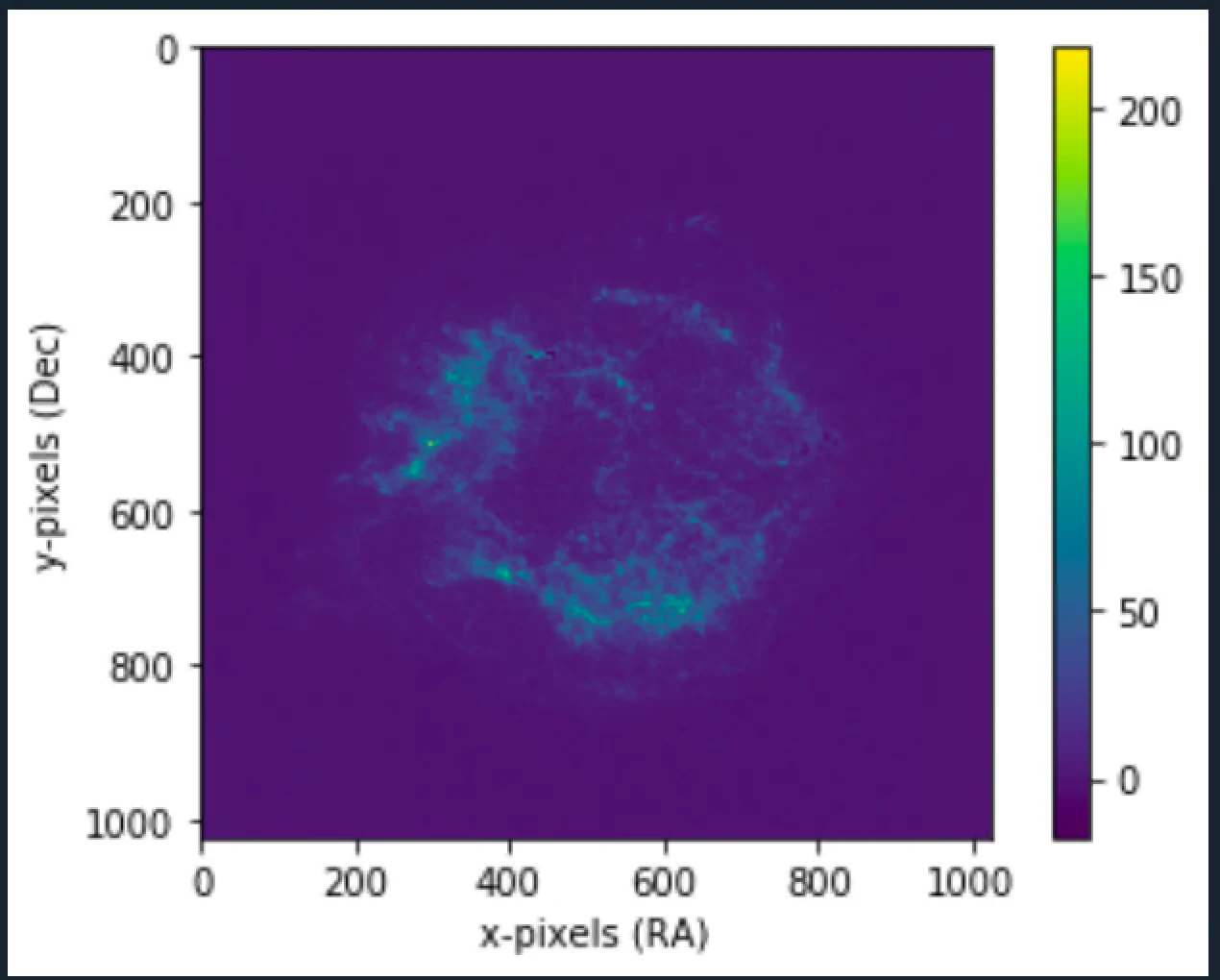
No of Bins = 4
2. No of Bins = 50
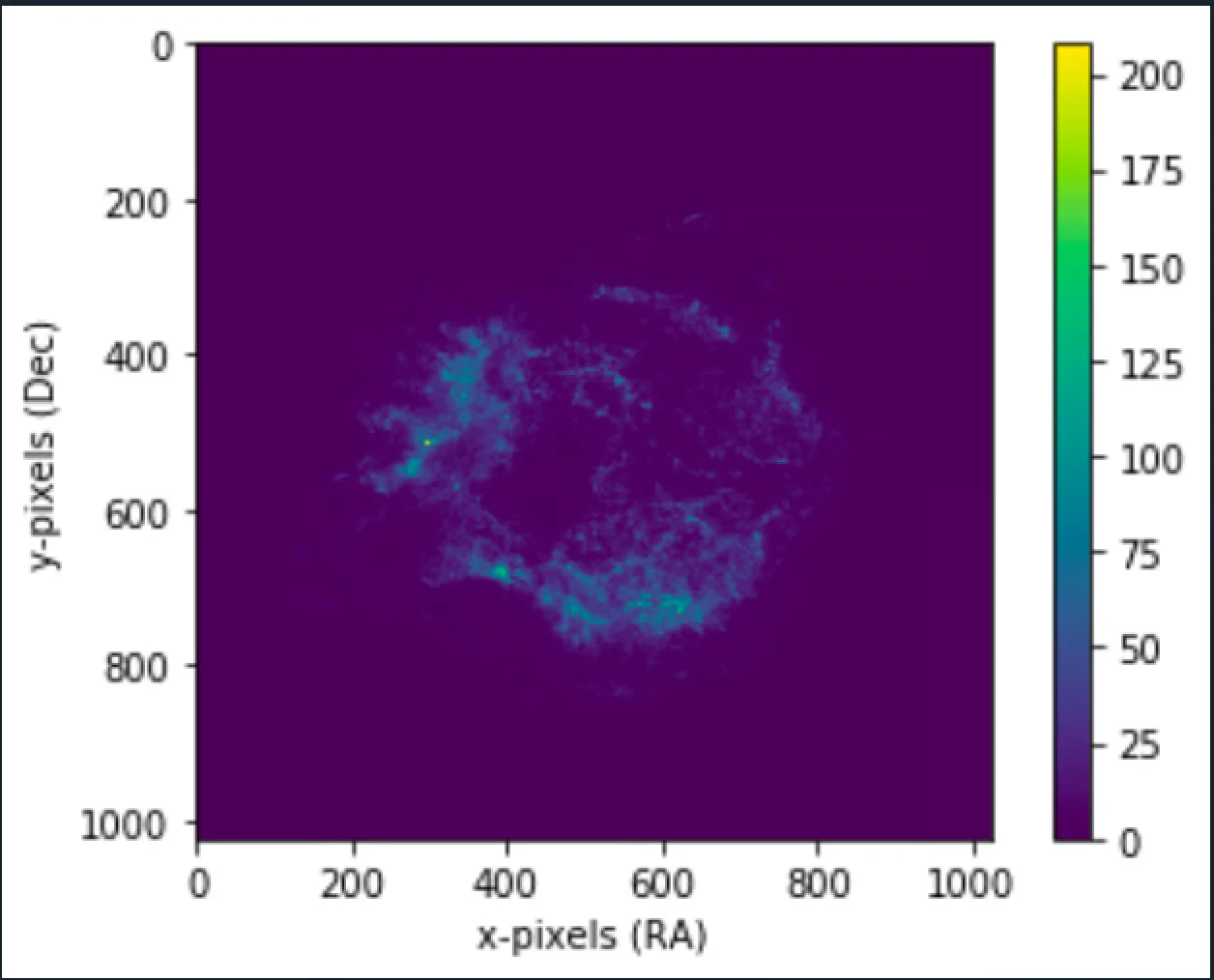
3. Bins: 150
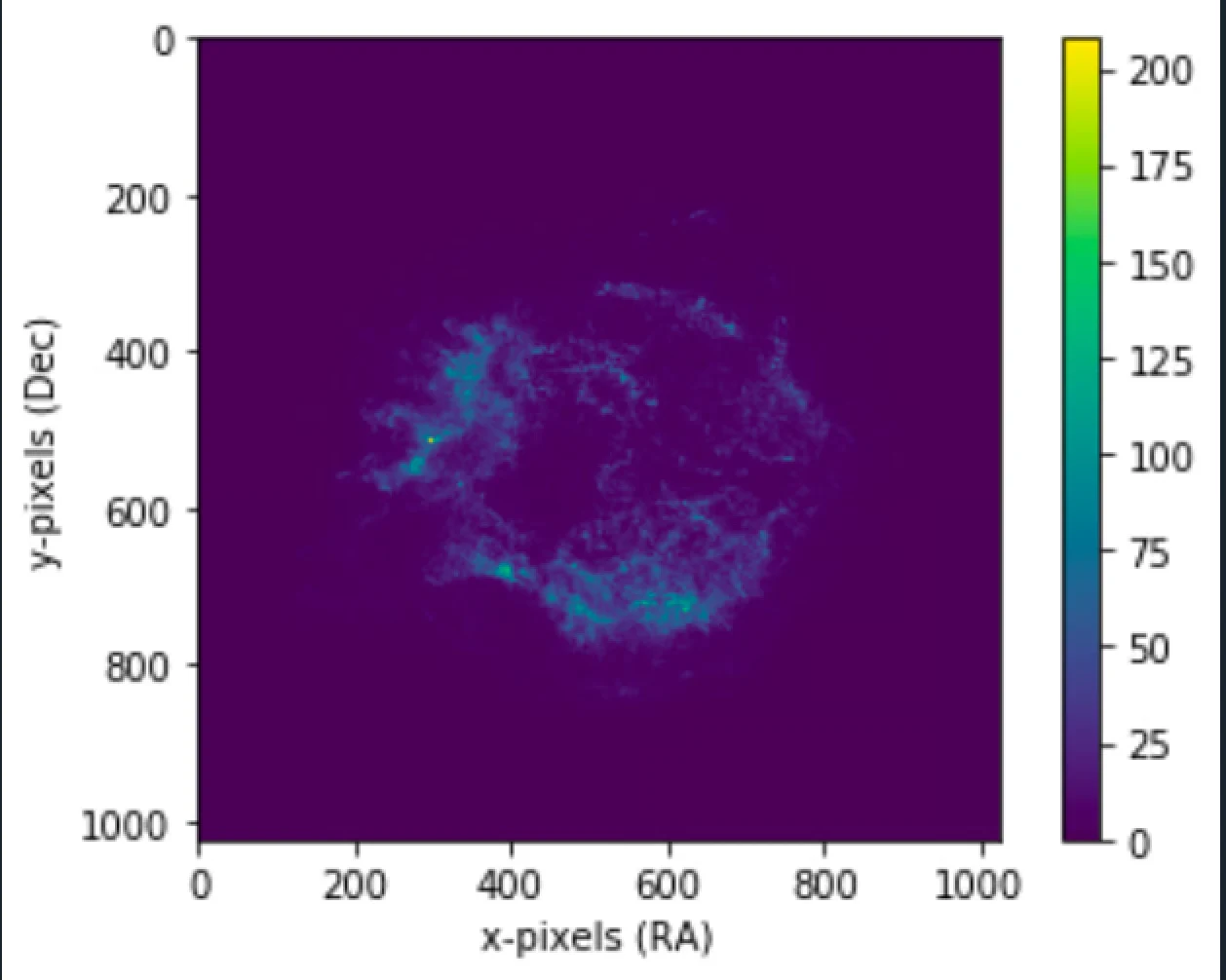
As number of bins increase, the brighter objects are more visible clearly, like in the left part of the image, we can see a very bright object at around RA = 250, Dec = 500 (Approx).
Typically astronomers use no of bins to be around 1000 and use hundreds of images. They also optimize further by parallelizing calculations further.
(Found some fits a part of Data Driven Astronomy Online Course by The University of Sydney)